

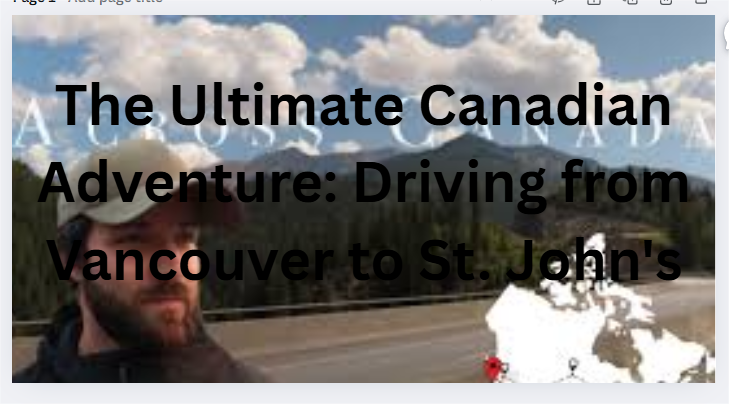
Let’s be honest, every Canadian has at least once looked at a map, traced the thin lines of the Trans-Canada Highway from the Pacific to the Atlantic, and felt a pull. A cross-country road trip from Vancouver to St. John’s is more than just a long drive; it’s a pilgrimage through the heart of a nation, a journey of over 7,000 kilometers that reveals Canada’s soul in all its vast, wild, and welcoming glory.
This isn’t a trip you decide to do on a whim. It’s an expedition that demands planning, a spirit of adventure, and a deep appreciation for the journey itself. If you’re dreaming of tackling this legendary route, here’s what you need to know to turn that dream into an unforgettable reality.
The Grand Itinerary: A Coast-to-Coast Blueprint
Trying to summarize Canada in a single route is impossible, but the Trans-Canada Highway is the thread that ties it all together. The drive itself, with no stops, would take about a week and a half of solid driving. But the magic isn’t in the driving; it’s in the stopping. Give yourself at least three to four weeks, if not more, to do it any justice at all.
The Starting Line: Vancouver, British Columbia
Begin in the stunning coastal city of Vancouver, nestled between mountains and ocean. Fuel up on great coffee, walk the seawall, and get one last taste of West Coast ease before you hit the road. Your first drive will be through the breathtaking Sea-to-Sky Highway towards the Rockies.
The Mountain Majesty: The Canadian Rockies
This is what postcards are made of. You’ll weave through British Columbia and into Alberta, with mandatory stops in Banff and Jasper National Parks. Here, the mountains aren’t just a backdrop; they are the main event. Pull over at Lake Louise, feel the spray from Athabasca Glacier, and keep your eyes peeled for elk and bears. This section alone could fill a week.
The Big Sky Country: The Canadian Prairies
As you leave the Rockies and enter Alberta, then Saskatchewan and Manitoba, the landscape transforms. The mountains give way to endless, rolling fields of gold and green. Some find this part monotonous; I find it meditative. The sky becomes a vast, ever-changing canvas. This is a time to put on a good podcast, roll down the windows, and feel the immensity of the country. Stop in Winnipeg for its vibrant arts scene and a taste of its rich cultural history.
The Great Lakes and Beyond: Ontario
Ontario is a beast. It makes up nearly half of the entire drive. You’ll skirt the northern shores of the Great Lakes, through Thunder Bay and Sault Ste. Marie. The landscape here is a rugged mix of Canadian Shield, endless forests, and countless lakes. It’s a long haul, but the beauty of Lake Superior Provincial Park is a stunning reward. Finally, you’ll hit the urban buzz of Toronto—a stark contrast to the wilderness you just left.
La Belle Province: Quebec
Crossing into Quebec feels like entering a different country. The language, the architecture, the food—it all changes. Montreal is a city of festivals and incredible food; don’t miss poutine in its homeland. Quebec City is a slice of old Europe with its stunning Château Frontenac and cobblestone streets. Soak in the culture; it’s a highlight of the trip.
The Final Stretch: The Atlantic Provinces
The home stretch is packed with maritime charm. You’ll drive through New Brunswick, cross the Confederation Bridge to Prince Edward Island with its red sand beaches, and then roll through Nova Scotia. The Cabot Trail is a world-class driving route worth a detour.
The Finish Line: St. John’s, Newfoundland
And then, you reach the edge of the continent. Arriving in St. John’s is an emotional moment. The colourful houses of Jellybean Row, the sound of the foghorn, and the view from Signal Hill where the Atlantic Ocean stretches out to infinity. It’s a powerful feeling of accomplishment. Have a “screech-in” ceremony, raise a glass, and know you’ve completed one of the world’s great journeys.
Planning Your Epic Drive: The Nitty-Gritty
A trip of this scale lives or dies on good planning.
When to Go: The absolute best time is late spring, summer, or early fall (May to September). You’ll avoid the treacherous winter driving conditions that can close roads, especially in the Rockies and Northern Ontario.
Your Vehicle is Your Best Friend: Get a full mechanical check-up before you go. Ensure your tires, brakes, and fluids are all in top shape. Consider roadside assistance—it’s cheap peace of mind for a trip this long.
Budgeting for the Long Haul: Costs can add up quickly. Budget for gas (a major expense), accommodation (mix camping with motels/Airbnbs to save), food (pack a cooler for picnics), and park entry fees. It’s not a cheap trip, but the memories are priceless.
What to Pack: Layers are key. You’ll experience everything from mountain chill to prairie heat. Essentials include:
- A reliable GPS and physical maps (for areas with no signal).
- A cooler for drinks and snacks.
- A good camera and binoculars for wildlife.
- A sense of adventure and patience.
The Mindset for the Long Road
This journey will test you. There will be long, boring stretches. You might get tired of being in the car. But that’s all part of it. Embrace the empty highways as much as the stunning vistas. Talk to locals in small-town diners. Be spontaneous—if you see a sign for a weird roadside attraction, stop! The goal isn’t just to get to St. John’s; it’s to experience every kilometer in between.
Driving across Canada changes you. It gives you a tangible sense of the country’s scale and diversity that you can’t get from a book or a plane window. It’s a story you’ll tell for the rest of your life. So start planning, hit the road, and discover Canada one kilometer at a time.
Conclusion: More Than Just a Drive
As you stand on the easternmost edge of the continent in St. John’s, with the vast Atlantic stretching out before you, the map you once traced with your finger becomes a tapestry of lived experience. The cross-Canada road trip from Vancouver to St. John’s fades from a checklist of destinations into something deeper: a collection of moments.
It’s the memory of the mountain air in the Rockies, the profound silence of the prairies, the rugged beauty of the Canadian Shield, and the unmistakable joy of arriving in a new city after a long day’s drive. It’s the taste of fresh salmon on the West Coast, a Peameal bacon sandwich in Toronto, poutine in Montreal, and lobster in the Maritimes.
Frequently Asked Questions
How long does the drive actually take without stopping?
If you were a driving robot, you could cover the roughly 7,000 kilometers in about 10 to 12 solid days of driving. But that’s not the point of this trip at all. That pace would mean doing nothing but driving for 10-12 hours a day and seeing nothing but the highway. To truly experience the journey, you need weeks, not days.
What’s the one thing I should absolutely not forget to pack?
Beyond the obvious like your wallet and phone? A physical road atlas or a dedicated GPS device. You will lose cell service for long stretches, especially in Northern Ontario, the Rockies, and parts of the Maritimes. Relying solely on your phone’s online maps is a recipe for getting lost. A cooler for drinks and snacks is a very close second.
Is it safe? What about wildlife on the roads?
It is very safe, but you need to be smart. The biggest danger, aside from driver fatigue, is wildlife. Dawn and dusk are high-risk times for collisions with deer, moose, and elk. Be extra vigilant during these times, use your high beams when possible, and if you see one animal, slow down immediately—there are often more following. Never swerve violently for a small animal; it’s more dangerous to lose control of your vehicle.
How much should I budget for the entire trip?
This varies wildly, but you should plan for a few key expenses. Gas will be your single biggest cost. Accommodation is next; camping is the budget-friendly hero, while motels and hotels will add up quickly. Then factor in food (eating out for every meal is expensive), and an emergency fund for unexpected car repairs. A rough estimate for a three-week trip for two people, mixing camping and motels, could be anywhere from $5,000 to $8,000 CAD, depending on your style.
Can I do this trip in the winter?
I would strongly advise against it for all but the most experienced winter drivers. The conditions through the mountain passes in BC and Alberta and the long, isolated stretches of Northern Ontario can be treacherous and unpredictable. Many secondary roads and attractions are closed. The summer and early fall offer not only safer driving but also access to all the national parks and scenic stops that make the trip special.
What’s the best part of the trip?
Everyone will give you a different answer, and that’s the beauty of it. For some, it’s the raw power of the Rockies. For others, it’s the meditative quality of the Prairies or the charming culture shock of Quebec. The “best part” is often a personal, unexpected moment—a conversation with a local, a perfect sunset over a lake, or the overwhelming feeling of accomplishment when you finally see the ocean in Newfoundland.