

If you’re sitting in the Express Entry pool—or preparing to enter it—you’ve likely asked yourself this exact question: What’s the lowest score that actually gets invited? Not the average, not the theoretical minimum, but the real, proven number that has landed people their Invitation to Apply.
It’s a fair question. And the answer is more hopeful today than it has been in months.
The Current Floor: 509 Points
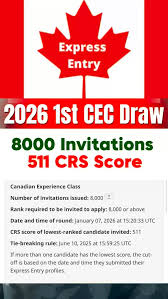
Let’s start with the most recent, verifiable fact. On January 21, 2026, Immigration, Refugees and Citizenship Canada (IRCC) invited 6,000 candidates under the Canadian Experience Class (CEC). The lowest Comprehensive Ranking System (CRS) score accepted in that draw was 509.
This wasn’t a fluke. Just two weeks earlier, on January 7, another large CEC draw invited 8,000 candidates with a minimum score of 511. That means within a single month, the floor dropped by two points and settled at a level not seen since September 2024 .
So if you’re looking for a concrete, current benchmark: 509 is the number to watch.
But That’s Not the Whole Story
Here’s where it gets interesting. That 509 number applies specifically to Canadian Experience Class candidates. It does not apply to everyone in the pool.
If you’re applying through the Provincial Nominee Program (PNP) , the numbers look completely different. On January 20, 2026, a PNP-specific draw required a minimum score of 746. On February 3, another PNP draw came in at 749 . Why the massive gap? Because PNP candidates already have 600 bonus points added to their score from their provincial nomination. Their “real” score without that bonus is often much lower.
And then there’s the French-language proficiency category. On February 6, 2026, IRCC invited 8,500 French-speaking candidates with a minimum score of just 400. That’s over 100 points lower than the CEC draw. This is category-based selection at work: Canada actively lowering the bar for specific, high-demand profiles.
The Bigger Trend: Scores Are Falling
Here’s what should give you genuine encouragement. The pool is becoming less top-heavy.
Between January 4 and February 2, 2026, the number of candidates with scores between 501 and 600 dropped by over 6,100 profiles—a decline of nearly 30% . These high-scoring candidates largely exited through the large January CEC draws. Meanwhile, the overall pool actually grew by about 2,300 people, mostly in the mid ranges.
What does this mean for you? Fewer people sitting above you in the rankings. Your percentile position improves even if your score stays the same. As of early February, candidates with scores in the 471–480 range fall approximately in the 75th to 82nd percentile of the pool . That’s not a guaranteed invitation, but it’s far from hopeless—especially if more large draws continue.
The One Exception That Proves the Rule
It’s worth noting the absolute lowest scores we’ve seen in recent years have come from category-based draws, not general or CEC rounds. The 400-point French draw on February 6 is the clearest example. If you have strong French skills (NCLC 7 or higher), you are essentially playing a different game with a much lower barrier to entry.
Similarly, healthcare and STEM occupations have seen targeted draws with scores significantly below general rounds, though specific numbers for early 2026 in these categories are still emerging.
What This Means for Your Score
If your score is:
- Above 510: You are in strong contention for a CEC draw. Recent history proves this.
- Between 490 and 509: You are on the cusp. The January 21 draw at 509 suggests the door is cracking open. Keep your profile updated and consider retaking your language test.
- Between 471 and 490: You are not out of the race, but patience is required. Your path may involve a provincial nomination, a category-based draw, or improving your score through language or work experience.
- Below 470: A general or CEC invitation is unlikely without significant improvement or a provincial nomination. This is your signal to explore PNP streams that match your profile.
The Honest Truth About “Lowest” Scores
Here’s what immigration forums and anxious waiting rooms don’t always tell you: There is no single “lowest score” that applies to everyone. The number depends entirely on:
- Which program or category you qualify for
- Whether you have a provincial nomination
- How many large draws IRCC decides to run
- How many high-scoring candidates have recently exited the pool
What’s true today is that 509 is the floor for CEC, and it’s the lowest we’ve seen in over a year . What’s also true is that the pool is shifting in savour of mid-scoring candidates. The competition at the very top is thinning.
Your Next Move
Don’t obsess over the single lowest number ever recorded. It’s a distraction. Instead, look at the sustained trend. IRCC has started 2026 with massive draw sizes—14,000 CEC invitations in January alone . They are clearing out the 500+ pool deliberately. This creates room.
If your score is in the high 400s, your job is to stay ready. Keep your language test valid. Keep your profile current. And if you’re eligible for a provincial nomination or a French-language draw, pursue that aggressively.
Frequently Asked Questions: The Lowest CRS Score Accepted
You’ve seen the draw numbers—509 for CEC, 400 for French, 749 for PNP. Now here are the real questions people are asking about what these scores actually mean for their chances.
Is 509 the new “low” I should expect for CEC draws?
Yes and no. The January 21 CEC draw at 509 is the lowest we’ve seen since September 2024 . But here’s what you need to understand: the score floor is moving downward. Two weeks earlier, the CEC cut-off was 511. It dropped two points in one month. More importantly, over 6,100 high-scoring candidates (501-600) have exited the pool since early January, and that number continues to grow -10. The competition at the top is thinning. If this trend holds, 509 may not be the floor for long—it could be the ceiling you’re chasing today.
How did French speakers get invited with only 400 points?
That 400-point draw on February 6 was not a glitch or a one-off -2-5. It was a category-based draw specifically for French-language proficiency. Candidates in this category are not competing against the general pool. They are competing only against other French speakers. If you demonstrate strong French ability (NCLC 7 or higher in all four skills), you are playing an entirely different game with a dramatically lower barrier to entry. Canada’s target is to grow Francophone communities outside Quebec, and they are actively lowering scores to meet that goal.
What is a “competitive” score right now? Not the minimum, but actually competitive?
This depends entirely on your category. For the Canadian Experience Class, scores in the 500-510 range are now genuinely competitive—not guaranteed, but you are in the conversation. For general “all programs” draws, you still likely need 570+. For Provincial Nominee Program draws, remember those 749 scores include 600 bonus points, so the underlying score is usually in the 140-150 range. For French draws, 400 is the new target . The old rule of “550+ or nothing” no longer applies across the board.